Get Free Ebook When to Rob a Bank: ...And 131 More Warped Suggestions and Well-Intended Rants, by Steven D. Levitt, Stephen J. Dubner
The method to get this book When To Rob A Bank: ...And 131 More Warped Suggestions And Well-Intended Rants, By Steven D. Levitt, Stephen J. Dubner is quite easy. You may not go for some places and spend the moment to only find the book When To Rob A Bank: ...And 131 More Warped Suggestions And Well-Intended Rants, By Steven D. Levitt, Stephen J. Dubner In fact, you could not consistently obtain the book as you want. Yet below, just by search and locate When To Rob A Bank: ...And 131 More Warped Suggestions And Well-Intended Rants, By Steven D. Levitt, Stephen J. Dubner, you could get the lists of the books that you really anticipate. Often, there are many books that are revealed. Those publications naturally will impress you as this When To Rob A Bank: ...And 131 More Warped Suggestions And Well-Intended Rants, By Steven D. Levitt, Stephen J. Dubner collection.
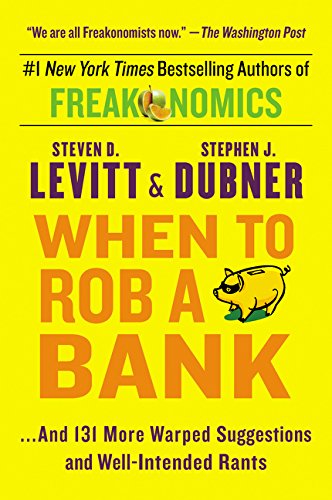
When to Rob a Bank: ...And 131 More Warped Suggestions and Well-Intended Rants, by Steven D. Levitt, Stephen J. Dubner

Get Free Ebook When to Rob a Bank: ...And 131 More Warped Suggestions and Well-Intended Rants, by Steven D. Levitt, Stephen J. Dubner
Is When To Rob A Bank: ...And 131 More Warped Suggestions And Well-Intended Rants, By Steven D. Levitt, Stephen J. Dubner book your preferred reading? Is fictions? How's about record? Or is the very best seller unique your selection to satisfy your leisure? Or even the politic or religious publications are you looking for now? Right here we go we provide When To Rob A Bank: ...And 131 More Warped Suggestions And Well-Intended Rants, By Steven D. Levitt, Stephen J. Dubner book collections that you need. Bunches of numbers of publications from many industries are provided. From fictions to science and also spiritual can be looked and also discovered here. You may not stress not to discover your referred publication to review. This When To Rob A Bank: ...And 131 More Warped Suggestions And Well-Intended Rants, By Steven D. Levitt, Stephen J. Dubner is among them.
The reason of why you could obtain and also get this When To Rob A Bank: ...And 131 More Warped Suggestions And Well-Intended Rants, By Steven D. Levitt, Stephen J. Dubner quicker is that this is guide in soft data form. You could read the books When To Rob A Bank: ...And 131 More Warped Suggestions And Well-Intended Rants, By Steven D. Levitt, Stephen J. Dubner wherever you really want also you are in the bus, office, house, and also other areas. But, you might not should relocate or bring guide When To Rob A Bank: ...And 131 More Warped Suggestions And Well-Intended Rants, By Steven D. Levitt, Stephen J. Dubner print wherever you go. So, you won't have heavier bag to bring. This is why your option making much better idea of reading When To Rob A Bank: ...And 131 More Warped Suggestions And Well-Intended Rants, By Steven D. Levitt, Stephen J. Dubner is truly valuable from this situation.
Recognizing the way the best ways to get this book When To Rob A Bank: ...And 131 More Warped Suggestions And Well-Intended Rants, By Steven D. Levitt, Stephen J. Dubner is also valuable. You have remained in ideal website to start getting this info. Get the When To Rob A Bank: ...And 131 More Warped Suggestions And Well-Intended Rants, By Steven D. Levitt, Stephen J. Dubner web link that we supply here and also visit the web link. You can get guide When To Rob A Bank: ...And 131 More Warped Suggestions And Well-Intended Rants, By Steven D. Levitt, Stephen J. Dubner or get it as quickly as possible. You can quickly download this When To Rob A Bank: ...And 131 More Warped Suggestions And Well-Intended Rants, By Steven D. Levitt, Stephen J. Dubner after obtaining offer. So, when you need guide quickly, you can straight receive it. It's so very easy therefore fats, right? You must prefer to through this.
Simply connect your tool computer or gizmo to the net connecting. Get the modern-day technology to make your downloading When To Rob A Bank: ...And 131 More Warped Suggestions And Well-Intended Rants, By Steven D. Levitt, Stephen J. Dubner finished. Even you do not wish to read, you can straight close guide soft file and open When To Rob A Bank: ...And 131 More Warped Suggestions And Well-Intended Rants, By Steven D. Levitt, Stephen J. Dubner it later on. You can also effortlessly obtain guide almost everywhere, because When To Rob A Bank: ...And 131 More Warped Suggestions And Well-Intended Rants, By Steven D. Levitt, Stephen J. Dubner it remains in your device. Or when remaining in the office, this When To Rob A Bank: ...And 131 More Warped Suggestions And Well-Intended Rants, By Steven D. Levitt, Stephen J. Dubner is also advised to review in your computer gadget.
In celebration of the 10th anniversary of the landmark book Freakonomics comes this curated collection from the most readable economics blog in the universe. It’s the perfect solution for the millions of readers who love all things Freakonomics. Surprising and erudite, eloquent and witty, When to Rob a Bank demonstrates the brilliance that has made the Freakonomics guys an international sensation, with more than 7 million books sold in 40 languages, and 150 million downloads of their Freakonomics Radio podcast.
When Freakonomics was first published, the authors started a blog—and they’ve kept it up. The writing is more casual, more personal, even more outlandish than in their books. In When to Rob a Bank, they ask a host of typically off-center questions: Why don’t flight attendants get tipped? If you were a terrorist, how would you attack? And why does KFC always run out of fried chicken?
Over the past decade, Steven D. Levitt and Stephen J. Dubner have published more than 8,000 blog posts on Freakonomics.com. Many of them, they freely admit, were rubbish. But now they’ve gone through and picked the best of the best. You’ll discover what people lie about, and why; the best way to cut gun deaths; why it might be time for a sex tax; and, yes, when to rob a bank. (Short answer: never; the ROI is terrible.) You’ll also learn a great deal about Levitt and Dubner’s own quirks and passions, from gambling and golf to backgammon and the abolition of the penny.
- Sales Rank: #70850 in Books
- Brand: Levitt Steven D
- Published on: 2016-05-10
- Released on: 2016-05-10
- Original language: English
- Number of items: 1
- Dimensions: 8.00" h x .90" w x 5.31" l, .0 pounds
- Binding: Paperback
- 400 pages
- When to Rob a Bank and 131 More Warped Suggestions and Well Intended Rants
Review
“Lively, self-deprecating writing ensures an entertaining read for fans and new readers alike.” (Publishers Weekly)
“[A] kooky and counterintuitive collection of economic analysis. ... Plenty to revel in.” (Kirkus)
“Levitt and Dubner... return with more of their signature humor and economic perspective on everyday life. ... Will be a hit with fans of Freakonomics.” (Library Journal)
Praise for the Freakonomics Books: “Genius... has you gasping in amazement.” (Wall Street Journal)
“We are all Freakonomists now.” (Washington Post)
“An afternoon with Levitt and Dubner’s book will transform you into the most interesting person in the room that evening.” (National Public Radio)
“A splendid book, full of unlikely but arresting historical details that distinguish the authors from the run of pop social scientists.” (New York Times)
“An addictive, irresistible crash course in the populist application of economics.” (The A.V. Club)
“Good ideas ... expressed with panache.” (Financial Times)
From the Back Cover
Surprising and erudite, eloquent and witty, When to Rob a Bank demonstrates the brilliance that has made the Freakonomics guys an international sensation, with more than 7 million books sold in 40 languages, and 200 million downloads of their Freakonomics Radio podcast.
When to Rob a Bank is Steven D. Levitt and Stephen J. Dubner’s curated collection from the most readable economics blog in the universe. Drawn from 10 years of entries on Freakonomics.com, where they employ a style that is more casual, more personal, and more outlandish than in their books, they answer such questions as: Why don’t flight attendants get tipped? If you were a terrorist, how would you attack? And why does KFC always run out of fried chicken?
You’ll discover:
- What people lie about, and why
- The best way to cut gun deaths
- Why it might be time for a sex tax
- And yes, when to rob a bank (Short answer: never; the R.O.I. is terrible)
You’ll also learn a great deal about Levitt and Dubner’s own quirks and passions, from gambling and golf to backgammon and the abolition of the penny.
About the Author
Steven D. Levitt, a professor of economics at the University of Chicago, was awarded the John Bates Clark Medal, given to the most influential American economist under forty. He is also a founder of The Greatest Good, which applies Freakonomics-style thinking to business and philanthropy.
Stephen J. Dubner, an award-winning journalist and radio and TV personality, has worked for the New York Times and published three non-Freakonomics books. He is the host of Freakonomics Radio and Tell Me Something I Don't Know.
Stephen J. Dubner is an award-winning author, journalist, and radio and TV personality. He quit his first career—as an almost rock star—to become a writer. He has since taught English at Columbia, worked for The New York Times, and published three non-Freakonomics books.
Most helpful customer reviews
88 of 91 people found the following review helpful.
If you have the perception that this is a 10th anniversary bit of memorabilia, it becomes a better read
By Apollo
This book isn't so much a book, let alone a sequel to Freakonomics, as it is a celebration of 10 years of the Freakonomics branded state-of-mind. Little to nothing here is presented as thoroughly researched forays into unrelated anecdotes but rather it is more of a ticket into the minds of Levitt and Dubner who show they think about various topics in somewhat different ways (such as "Why Don't Flight Attendants Get Tipped?"). The book does expand beyond this idea of understanding the psychology of economists as well, offering "fun sized" pieces of Freakonomics, such as the story/stories about Jane Siberry. Additionally, there are just genuinely fun parts that celebrate the decade long run of this "new" way of thinking, as evident through the author's contests.
If you are expecting to thoroughly understand when to rob a bank or the cost of fearing strangers, then you should look elsewhere. This book is more of a piece of memorabilia that marks the 10th anniversary of the Freakonomics brand (the original book was published in 2005). The same way that die hard Harry Potter fans might purchase J.K. Rowling: A Bibliography 1997-2013, and fans of the Andy Griffith Show might purchase Mayberry Memories: The Andy Griffith Show Photo Album, fans of Freakonomics should buy this book to have a look behind the scenes of the mindset of the authors. Plus there are little bonuses along the way.
Now, most of this book, if not all of this book is from their blog. Which means most of this book, if not all of this book is available online. For free. So why did I buy it? For the same reason that people bought Malcolm Gladwell's What the Dog Saw: And Other Adventures: simply just to have a nice, updated collection of the author's/authors' anthology in the form of a tangible item. As for charging people for free material, perhaps the authors say it best: "Having grown up on the middle of nowhere himself, Dubner had always thought it strange that so many people would pay good money for a bottle of water. And yet they do, to the tune of roughly $100 billion a year. Suddenly a book of blog posts didn't seem so dumb. So in the tradition of Poland Springs, Evian, and other hydro-geniuses, we've decided to bottle something that was freely available and charge you money for it." Levitt and Dubner are just responding to incentives.
If it seems a little odd then that this is only a 3 star review given what I have been previously trying to argue, that is because there are still some aspects that take away from the experience. Poor editing is one. For example, on page 38, the first sentence in the section "The Next Time Your Daughter Brings Home A New Boyfriend, Be Sure To Ask His Middle Name," Levitt writes: I got an interesting a package..." (the authors write their blog posts separately they explain early in the book. So yes, it is Levitt as the SDL indicates below the entry's title.) This piece about middle names also serves as another example for how the book falls short. Some of these "taste" of Freakonomics, the pieces that seem like they are the springboard into something truly fascinating, do not go anywhere. Although, it truly seems like they should. The source of this middle name material came from a reader who had sent the authors pieces of articles that showed crimes were being committed by people whose middle names were Wayne. But there is nothing more than that. An anecdote like this begs an explanation, yet there is none to be found. It would be like if the (in)famous abortion piece was shortened to a couple of pages that essentially stated: "After decades of escalation, the rate of crime is dropping!" Pieces like this should have been excluded as to been further elaborated on in a true sequel (if that true sequel should ever happen).
Finally, why this book is getting 3 stars (from me anyway) is because of the authors' habit of providing theoretical solutions or conclusions in the forms of one or two sentences. It is one thing to show where the sources of their "What if..." or "How come..." questions originate from. It is further interesting to illustrate the seeds of these ideas that have presumably bloomed into full fledged Freakonomic pieces (as was partially the purpose of the Beatles Anthology CDs). But after only a few pages of introducing an idea, sometimes even far less, the authors will from time to time end by saying something along the lines of "My guess is that..." or "It would be better if..." These solutions and explanations and conclusions are not rooted in anything except for speculation. Which is something that anyone can do. Readers should not expect an answer for every problem in this book because this book is not about that. It is 131 examples of how to think differently (which does a better job by doing it indirectly than the direct approach of Think Like a Freak: The Authors of Freakonomics Offer to Retrain Your Brain). And there are some gems in the 131 examples. But the abbreviated conclusions negate these introductions to new ideas because they are not founded in data. Nor years of research. It is just the authors attempting to wrap up these little bits of stories by inserting their opinions. Which seems odd for the world of Homo economicus. Not to say that the authors shouldn't insert their opinions. But even when they blatantly say that it is a guess, it still undermines the fact that their actual conclusions of former pieces are based on data. And their success is based on their unique interpretation of the data.
All in all, it is an nice, quick read. It introduces some interesting thoughts but it does not take the time to explore them. Because that is not what this book is about. It is about the fact that for 10 years, the world has been shown how to think differently. That the world is not black and white. Nor are there just many shades of grey. But often, you may find hues of fuchsia. It is an anniversary of the creation of something interesting and addictive. It is a celebration that people from all walks of life have come together to join in on becoming Freaky. Through all its faults, and the faults are there, When To Rob A Bank is a nice afterward to the first decade, a little memento from Misters Levitt and Dubner.
15 of 15 people found the following review helpful.
if you are willing to sort through a decade of blogs to hand pick the best of them
By L. M. Masson
Ah, come on folks. The reviews are harsh, and the Steves are up front. You can read this for free on the blogs, if you are willing to sort through a decade of blogs to hand pick the best of them. If you find the blogs entertaining, and you don't mind reruns, then the book is great. I don't mind repeats. I haven't read every blog, or even most of them. There is also the comfort of having dead tree material in my hand for a change...
It's a good read, and you'll chuckle. What more do you want?
0 of 0 people found the following review helpful.
Potpourri
By Phillip Schultz
For a collection of blog posts, this isn't bad. It is the fourth book in the Freakonomics series. I can't compare this to the others because I haven't read them. I imagine this one is a bit more freeform. They loosely tie their selections together under some pretty broad categories.
These guys are clearly intelligent. Despite some quirky subjects, they do take themselves fairly seriously. It happened that I was reading this while taking an economics course, so it was fairly relevant for me. I think this made the book more enjoyable than I would have found it otherwise.
If I had to do it over again, I would want to read Freakonomics first, then maybe come to this book.
When to Rob a Bank: ...And 131 More Warped Suggestions and Well-Intended Rants, by Steven D. Levitt, Stephen J. Dubner PDF
When to Rob a Bank: ...And 131 More Warped Suggestions and Well-Intended Rants, by Steven D. Levitt, Stephen J. Dubner EPub
When to Rob a Bank: ...And 131 More Warped Suggestions and Well-Intended Rants, by Steven D. Levitt, Stephen J. Dubner Doc
When to Rob a Bank: ...And 131 More Warped Suggestions and Well-Intended Rants, by Steven D. Levitt, Stephen J. Dubner iBooks
When to Rob a Bank: ...And 131 More Warped Suggestions and Well-Intended Rants, by Steven D. Levitt, Stephen J. Dubner rtf
When to Rob a Bank: ...And 131 More Warped Suggestions and Well-Intended Rants, by Steven D. Levitt, Stephen J. Dubner Mobipocket
When to Rob a Bank: ...And 131 More Warped Suggestions and Well-Intended Rants, by Steven D. Levitt, Stephen J. Dubner Kindle

Tidak ada komentar:
Posting Komentar